Texas Pastel Member
meeting
October 5, 2015
The October Texas Pastel Society Meeting was held at the Coppini
Art Academy. 16 members and 2 guests were in attendance.
Cindy started the meeting by introducing the Board and having each
attendee introduce themselves. Jerry then introduced our
demonstrator, Enid Wood. Enid has her studio in Bastrop.
“She studied still life and portrait painting at Westminster
College in Salt Lake City with Don Doxey. Her subsequent career as a
violin teacher took her to Berkeley, New Haven, London, Pittsburgh,
and Bastrop, TX. Ten years ago, inspired by the beautiful paintings
and places seen during her travels, she joined Albert Handell’s
mentorship program in New Mexico and became a full time painter.
She has also studied pastel painting with Linda Wallen, Doug Dawson,
Terri Ford, Duane Wakeham, Fred Somers, Dina Gregory, Rita Kirkman,
Richard McKinley, Elizabeth Castonguay, Judy Mattei, Dawn Emerson,
Clayton Beck, Mike Beeman, Sally Strand, and Suchitra Bhosle. “
Enid described the pastels she uses and how she began first using
Pan Pastels. These first came in “stacks”, but someone invented
a tray (like a shallow muffin tin) that would hold and protect the
individual colors. In addition to standard colors, these pastels
also come in metallic and pearlescent colors.
She normally uses stick pastels (of varying softness) on top of
the Pan Pastels. She applies the pastels with a variety of soft foam
tools made for this purpose, but often uses cheaper foam cosmetic
sponges. She touches a color two or three times before applying the
pastel to the surface. For the demonstration she used pre-mounted
UART 400.
Enid normally does not start with a drawing, particularly when
painting in Plein Aire. The pastels will work on a variety of
surfaces, including Canson. The Pan Pastels go on really fast. In
general soft pastels such as Terry Ludwig and Schminke will go on top
of the Pan Pastels, but pastel pencils are problematic.
The Pan Pastels can be blended, hence there is no need to purchase
different values of each color. This is accomplished by dabbing the
sponge on several colors (such as blue and white to get a lower value
of the blue). Enid demonstrated the use of two or three
complementary colors to easily obtain the desired shade of New Mexico
soil. She used paper towels to clean the surface of the Pan Pastels.
Edges can be achieved by using pencils or vine charcoal, or by
using sponges with sharp corners. Plastic palette knives fitted with
foam covers can also be used for details. She finished (at least
85%) the picture using Terry Ludwig pastels to add “pops of color”.
The meeting was adjourned for lunch. After lunch Enid conducted a
workshop.
Texas Pastel Member
meeting
September 12, 2015
The September Texas Pastel Society Meeting was held at the Coppini
Art Academy. 19 members and 2 guests were in attendance.
Jerry Henkener started off the meeting circulating 3 sign up
sheets for Kay Brooks. 1) the attendance list, 2) a sign up sheet
for the October 3
rd Enid Wood workshop, and, 3) a sign up
sheet for those interested in hanging their art in several San
Antonio locales.
The meeting continued with an introduction of our officers and our
guests. News from the floor included Cindy Morawski’s appointment
as artist for the Mitchell Lake Audobon Center, Mary Lopez’s new
classes at the San Antonio Jerry’s Artarama and Georgia Stok’s
classes.
Upcoming events include the October 3
rd meeting
(starting at 10:30) that will feature a demonstration of pan Pastels
by Enid Wood. From 1:00 to 4:00 Enid will conduct a workshop. The
demo is free to all members. The workshop will be $50 for members
and $60.00 for non-members.
November will feature our all members show at the Coppini.
Details are still being arranged. Gaye Sekula will judge the show.
She is an oil painter and pastelist, teaching at the NBAL in both
media. She is featured in a number of galleries in the southwest and
was recently selected as ambassador to the various Texas portrait
painting societies. There will be a reception and an entry fee to
cover prizes.
Next meeting will be in February. Currently, Jeannette Cuevas is
scheduled to be the demonstrator, showing her landscape painting
techniques. For March, we are considering a paintout at one or more
of the San Antonio Missions, an opportunity to paint San Antonio’s
new world heritage site.
Our demonstration was by Libby Peters. She
is a nationally recognized portrait artist whose work is included in
the collections of legislators and families across America and
England. She is a signature member of the pastel Society of America,
the Pastel Society of the Southwest and a member of the Portrait
Society of America, Oil Painters of America, the Degas Pastel Society
and Past President, Exhibition Chair and Webmaster of the Austin
Pastel Society. She has been published in a number of journals and
books and won numerous awards.
Libby demonstrated her techniques, painting from an iPad, using an
Artist Grid app. She had prepared ahead of time several stages of
her work, which allowed her to demonstrate what is a meticulous
process. As she pointed out, a recognizable likeness requires
getting tiny differences right.
She selected a fixed reference point (the most prominent feature)
and a fixed reference measurement, typically the inside and outside
of an eye. Everything is then carefully positioned and measured from
this point. In order to accurately locate the portrait, especially
if it is her preferred ¾ length, she will divide the paper into
squares, with either the vertical or horizontal being in halves, in
order to ensure fit.
Libby then concentrated on the reference point and proceeded to
lay out the pupil and work her way out, layering pastel (or, as she
called it, chipping away”) to correct the shape. She spends more
time on the first eye than anything else, often taking 3 hours or
more to get the effect she wants. She used pastel pencils (or
sometimes a broken pastel to blend and get the small details.
She then turned the picture upside down and proceeded to correct
any details that did not seem right. Then, still working upside
down, proceeded to expand outward from the eye, working, blending and
correcting as she went along. She indicated that she typically
finishes the nose and mouth last, as these tend to move as the
subject moves.
At one point, she added some background (in this case a dark
green, since the background was shrubs), but no detail. She noted
that this was necessary in order to assure that the correct values
and colors were selected as the portrait proceeded. Turning the
picture right side up, Libby began adding hair, using long brush like
strokes and starting with the darker highlights.
Libby used a variety of pastels, harder Giraults for their ability
to hold an edge, American, and other softer pastels with a lighter
touch as the portrait progressed.
The meeting ended with a brief question and answer session and
many thanks to Libby for presenting a very difficult subject an
informative and entertaining manner.
Secretary
Roger W. Snyder
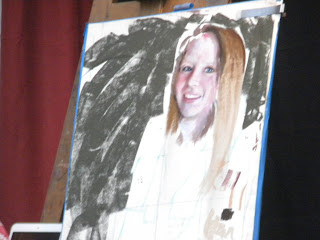 |
| Thank you Libby! |


